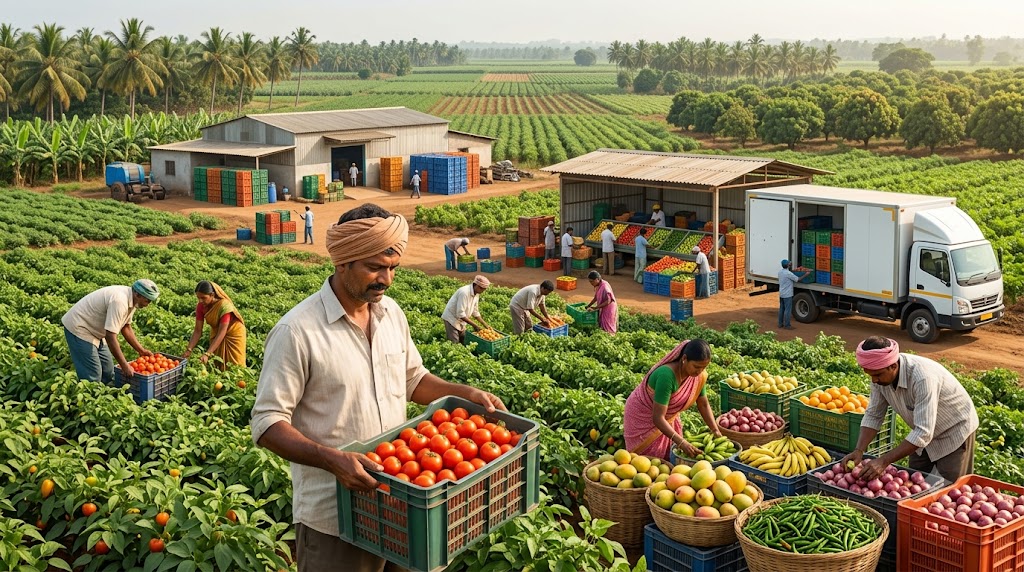
India’s horticulture sector is becoming an important source of growth for agriculture and the wider rural economy. Rising demand for fresh fruits, vegetables, spices and processed food is creating opportunities not only for farmers but also for food manufacturers, exporters, logistics companies and small businesses. As the country’s food market expands, horticulture is emerging as an industry where better production, efficient supply chains and value addition can create new sources of income.
The scale of production highlights the sector’s growing importance. India’s horticulture output is projected to reach approximately 377.78 million tonnes in 2025–26, with fruits and vegetables accounting for the largest share. This expanding production base creates considerable commercial potential, but it also raises an important question: how can the country ensure that higher agricultural output translates into better earnings for farmers and sustainable opportunities for businesses?
The answer lies in building stronger connections between farms, markets, processing facilities and consumers. The future of horticulture will depend not simply on growing more crops, but on reducing waste, improving quality and ensuring that agricultural produce reaches the right markets at the right time.
High-Value Crops Are Reshaping the Economics of Farming
For Indian farmers, horticulture offers an opportunity to diversify beyond traditional field crops and respond to changing market demand. Fruits, vegetables, spices, nuts and plantation crops serve a wide range of consumers and industries, from household kitchens and restaurants to food-processing factories and export businesses.
Crops such as mangoes, bananas, onions, cashew and coconut support extensive commercial networks. Depending on local growing conditions, investment requirements and access to buyers, selected horticultural crops can generate attractive returns from relatively limited land.
However, higher-value crops also bring greater responsibilities and risks. Farmers may need to invest more in irrigation, quality planting material, labour and crop protection. Perishable produce must be harvested and transported carefully, while prices can change significantly according to seasonal supply and demand.
This makes market access a crucial part of successful horticulture. Farmers need reliable information about prices, consumer preferences and buyer requirements before deciding what to grow. Stronger relationships with wholesalers, retailers, food processors and exporters can help reduce uncertainty and improve commercial planning.
For businesses, the opportunity extends to providing agricultural inputs, technical services, procurement support and market connections. Companies that help farmers produce consistent quality and reach dependable buyers can become valuable partners in the agricultural supply chain.
Rising Production Is Creating Opportunities Beyond the Farm
India’s expanding horticultural output supports a much larger economy than cultivation alone. Every harvest creates demand for collection, sorting, grading, packaging, transportation, storage and retail distribution.
Food manufacturers need dependable supplies of fruits and vegetables. Supermarkets and grocery businesses require products that meet consistent quality standards, while restaurants, hotels and institutional kitchens depend on timely deliveries. Meeting these needs creates opportunities for businesses that can organise agricultural supplies efficiently.
Small entrepreneurs can establish collection centres, provide transportation services or supply packaging materials. Larger businesses can invest in procurement networks, modern distribution facilities and integrated supply-chain operations.
Farmer-producer organisations and cooperatives can also play an important role by bringing smaller growers together. Collective marketing allows farmers to combine volumes, negotiate with buyers and potentially access markets that would be difficult to serve individually.
The economic benefit is significant when more activities take place close to producing regions. Instead of selling raw produce alone, rural communities can earn additional income through sorting, packing, processing and distribution. These activities can create local employment and help agricultural districts develop a broader business base.
Food Processing Can Turn Produce into Higher-Value Products
One of the biggest opportunities in India’s horticulture sector lies in food processing. Fresh fruits and vegetables have a limited shelf life, and their value can decline quickly when storage and transportation facilities are inadequate. Processing provides an alternative by converting agricultural produce into products that can be stored, transported and sold over longer periods.
Mangoes and other fruits can be processed into pulp, juices, concentrates and dried products. Tomatoes and vegetables can be used to manufacture sauces, pastes, frozen foods and packaged ingredients. Coconut, cashew and spices offer opportunities in packaged foods, ingredient production and branded consumer products.
India’s established export markets for processed fruits, juices and vegetables demonstrate the commercial potential of these activities. Domestic demand also creates opportunities as consumers seek convenient food products and manufacturers look for dependable sources of agricultural ingredients.
For small and medium-sized enterprises, food processing can provide a practical route into the horticulture value chain. Businesses can specialise in cleaning, cutting, drying, packaging or producing region-specific food products without necessarily competing directly with large agricultural producers.
Success, however, depends on careful business planning. Processing units need consistent supplies of raw materials, suitable machinery, trained workers and access to buyers. Entrepreneurs must also account for energy costs, packaging expenses, food-safety requirements and distribution margins.
When these factors are managed effectively, processing can reduce wastage, create additional demand for farm produce and help agricultural regions retain more value locally.
Cold Storage and Better Logistics Can Protect Farm Income
A large harvest does not automatically translate into higher earnings. When produce reaches the market in poor condition or arrives when supply is already abundant, farmers can lose a substantial part of its potential value.
Cold storage, refrigerated transportation, packhouses and modern handling facilities can help address this problem. By maintaining suitable storage conditions and improving the movement of produce, these services can extend shelf life and connect farmers with markets farther away.
The business opportunities range from small collection and grading centres to larger cold-chain networks serving food manufacturers, retailers and exporters. Packaging suppliers, warehouse operators and transportation companies can also benefit from the growing need for efficient agricultural logistics.
Better infrastructure can give farmers more options when deciding where and when to sell. Buyers benefit from improved quality and more reliable supplies, while processors can manage their raw-material requirements more effectively.
Yet cold storage is not a one-size-fits-all solution. Facilities need suitable locations, dependable electricity, efficient operations and sufficient demand to justify their costs. Investment is most effective when storage is connected to production clusters, transport networks and actual market requirements.
Export Markets Offer Scope for Further Growth
India’s varied climate and agricultural diversity allow it to produce a wide range of fruits, vegetables, spices and plantation crops. This creates opportunities for exporters to serve overseas markets and for domestic businesses to participate in international supply chains.
Fresh produce exports can generate demand for growers, packaging companies, quality-testing facilities and specialised logistics providers. Processed products can open additional opportunities by offering buyers alternatives to perishable shipments.
However, international markets often require strict attention to quality, grading, food safety and traceability. Exporters must understand the regulations of destination countries and ensure that products remain in suitable condition throughout transportation.
These requirements can encourage investment in modern packhouses, testing facilities and temperature-controlled logistics. Farmers who work with organised exporters may also receive clearer guidance on product specifications and harvesting practices.
The next stage of growth will depend on building dependable supply networks and developing products that meet specific market needs. Expanding exports is not simply a matter of increasing production; it requires consistency, efficient logistics and a clear understanding of what international buyers are willing to purchase.
Technology Is Improving Production and Market Access
Technology is gradually changing the way horticultural businesses operate. Weather information, digital crop advisories, improved irrigation and modern monitoring systems can help farmers manage water, respond to pest risks and make better decisions about harvesting.
These improvements are particularly relevant to horticulture, where product quality and timing can strongly influence selling prices. Timely advice and better farm management can help reduce avoidable losses and improve the consistency of output.
Digital platforms can also help farmers access price information and connect with potential buyers. For businesses, technology can support inventory management, procurement planning, quality checks and transportation coordination.
Small farmers may find it difficult to afford advanced equipment or digital services independently. Cooperatives, farmer-producer organisations and local service providers can help share costs and make useful technology more accessible.
The real value of agricultural technology lies in its ability to improve commercial outcomes. Better productivity matters, but so does reducing waste, meeting buyer requirements and ensuring that farmers receive a fair return for their efforts.
Investment and Government Support Remain Important
Developing a stronger horticulture economy requires investment in infrastructure, training, financing and market access. Public programmes supporting crop diversification and agricultural development can help farmers explore suitable crops and encourage businesses to invest in post-harvest facilities.
Regional planning is particularly important because growing conditions differ widely across India. Coastal areas, hill regions and northeastern states have different advantages in terms of climate, crop suitability and access to markets. Development strategies must reflect these differences.
Access to affordable finance is equally important. Farmers may need funding for irrigation, quality planting material and improved cultivation methods, while entrepreneurs may require capital for processing equipment, storage facilities and packaging operations.
Investment in cultivation alone will not be enough. Roads, collection centres, processing capacity and reliable buyers must develop alongside production if farmers and businesses are to benefit from rising output.
Stronger partnerships between farmers, financial institutions, processors and market operators can help ensure that investment addresses genuine commercial needs.
Price Volatility and Rising Costs Remain Major Challenges
Despite its potential, horticulture carries significant financial risks. Unpredictable weather, pest outbreaks, rising labour costs and fluctuating market prices can affect profitability. Perishable crops are especially vulnerable when farmers have limited storage facilities or few alternative buyers.
A sudden increase in supply can push prices down even when production is strong. Farmers may then struggle to recover the cost of cultivation, while processors and traders face uncertainty over procurement prices and operating margins.
Small growers can also face difficulties supplying large buyers because individual farms may not produce sufficient quantities or consistent quality. Collective marketing, shared infrastructure and longer-term procurement relationships can help overcome some of these barriers.
Businesses entering the sector must carefully assess local production patterns, market demand, transport expenses and the availability of raw materials. Commercial success depends on managing the entire value chain rather than focusing on a single stage.
Reducing these risks will be essential if horticulture is to deliver sustainable income growth for farmers and long-term opportunities for rural enterprises.
The Road Ahead: Building a Stronger Horticulture Business Ecosystem
India’s horticulture sector is creating opportunities across agriculture, food manufacturing, logistics, retail and exports. Rising production provides a strong foundation, but the next phase of growth will depend on how efficiently the country converts that output into products that consumers and businesses value.
For farmers, the priority is to improve profitability through suitable crop selection, better quality and dependable market connections. For entrepreneurs, opportunities lie in solving practical problems involving storage, processing, packaging and transportation. For food manufacturers and retailers, stronger supply networks can improve product availability and reduce procurement difficulties.
The sector also offers a pathway to broader rural development. Processing units, collection centres, warehouses and distribution businesses can create jobs beyond cultivation and encourage more economic activity within agricultural regions.
India has already built a substantial horticultural production base. The challenge now is to ensure that more produce reaches markets in good condition, that farmers benefit from the value they create and that businesses can operate profitably throughout the supply chain.
With better infrastructure, suitable technology, reliable financing and stronger market relationships, horticulture can become an increasingly important driver of agricultural growth, rural entrepreneurship and value-added food production.