Bhopal, Dec 3: The “Vishwarang 2025 – Tagore International Literature and Arts Festival,” held at the Ravindra Bhavan campus, successfully concluded its four-day run, marked by a majestic and deeply emotional finale, encompassing rich creative, intellectual, and cultural dimensions. This grand event was inaugurated by the Governor Shri Mangubhai Patel, with the former President of the Republic of Mauritius, Shri Prithvirajsing Roopun, attending as the Chief Guest. On the second day, Chief Minister Dr. Mohan Yadav participated in the programme, describing it as a celebration of Madhya Pradesh’s creative consciousness. The valedictory session was presided over by former Union Minister of Education, India, and senior litterateur, Shri Ramesh Pokhriyal ‘Nishank’.
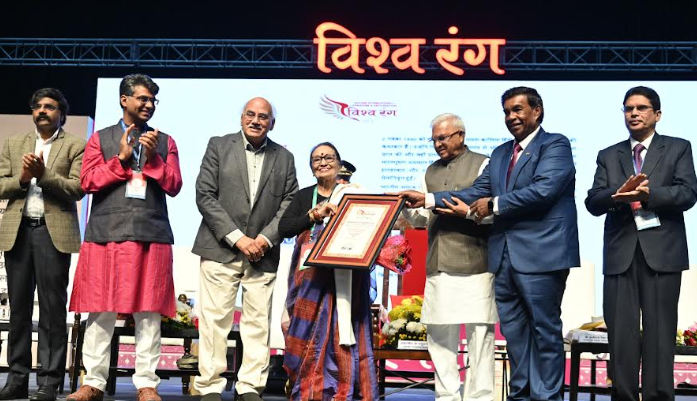
Organised jointly by the Vishwarang Foundation and Rabindranath Tagore University, in collaboration with the Department of Culture, Government of Madhya Pradesh, this seventh edition witnessed widespread participation from litterateurs, artists, academicians, thinkers, and youth from both India and abroad. This broad engagement truly transformed the festival into a global cultural confluence (Mahakumbh). This year, Vishwarang achieved a remarkable global reach, connecting with over 47 million (4.7 Crore) viewers worldwide through digital platforms, social networks, and direct participation, marking a significant milestone in the history of Indian literary and cultural events.
Key Highlights and Eminent Participation
Inauguration — On November 27, Governor Shri Mangubhai Patel hailed Vishwarang as a strong cultural bridge between Indian tradition and modern consciousness, emphasising that such events provide a global platform for languages and cultural heritage. Chief Guest Shri Prithvirajsing Roopun described Indian literature as a universal messenger of human sensitivity, stating that “Vishwarang” offers the global society a vision of cultural balance and emotional harmony. The session was attended by dignitaries including Shri Santosh Choubey, Director General of Vishwarang and Chancellor of Rabindranath Tagore University; Dr. Siddharth Chaturvedi, Chancellor of SCOPE Global Skills University and Co-Director of Vishwarang; and Dr. Aditi Chaturvedi Vats, Pro-Chancellor, Rabindranath Tagore University, and Co-Director of Vishwarang.
Chief Minister’s Address — Inaugurating the main ceremony on the second day, Chief Minister of Madhya Pradesh, Dr. Mohan Yadav stated that Bhopal is now emerging as a major hub for Indian linguistic consciousness and global literary dialogue, and that Vishwarang is the festival of Madhya Pradesh’s creative soul.
Auspicious Start — The second day commenced with an invocation (Mangalacharan) by the Dhrupad Sansthan. The sweet harmony of the Tanpura and the melodic waves of Raga Bhopali, Yaman, and Kedar steeped the atmosphere in spiritual musical devotion.
Intellectual and Creative Dialogues
Thought-provoking sessions were held on topics such as “21st Century Questions – Literature, Society and Culture,” “Skills for the New Century,” and the Crisis of Human Consciousness and Language Erosion in the Age of AI. Speakers including Dr. Nandkishore Acharya, Santosh Choubey, Ankur Warikoo, Akash Chopra, and lyricist Swanand Kirkire engaged in conversations with the youth. The third day featured special dialogue sessions with journalist Saurabh Dwivedi and actress Sanya Malhotra, offering inspiring discussions on the acting process, self-discipline, and life’s struggles.
Over 12 parallel stages ran for three days, hosting extensive deliberations on diverse subjects: “From Kautilya to Corporate,” “Century’s Concerns in Stories and Poetry,” “The New Language of Literature and Young Writing,” “Cinema – Yesterday, Today, and Tomorrow,” “Changing Narrative on OTT,” “India’s Emerging Sporting Power,” “Dimensions of Virtual Communication,” “War and Anti-War Art,” and “Meet the Author.” Esteemed personalities such as Radhakrishnan Pillai, Faizal Malik, Divya Dutta, Rajendra Gupta, Divya Prakash Dubey, Mamta Kalia, Nilotpal Mrinal, Shivmurti, Pushpesh Pant, Priya Malik, Sumit Awasthi, and A. Aravindakshan participated in these forums.
Sessions focusing on Diasporic Literature saw participation from creators from the Netherlands, Sharjah, Sri Lanka, Sweden, Italy, America, Belgium, Canada, Myanmar, Bahrain, Japan, and Indonesia, who shared insights on language preservation, cultural identity, and teaching methodologies in a global context.
Awards and Cultural Showcase
Vishwarang Samman — Senior creators from various Indian languages were honoured with the “Vishwarang Samman” during the inaugural session.
Tagore International Painting Competition — On the final day, 100 young artists selected from thousands of entries received from India and abroad were felicitated in the 7th Tagore International Painting Competition. Each evening of the festival was illuminated by vibrant cultural performances. Audiences warmly received the Malvi folk dance presented by Tripti Nagar, Shubhrat Sen’s Bengali folk music, Shri Ram Kala Kendra’s Krishan Leela, the Deshrag presentation, and the singing by the Collective Choir Band. The closing evening was made unforgettable by Bollywood singer Sona Mohapatra, who performed popular songs like “Bedardi Raja,” “Aigiri Nandini,” “Chhap Tilak,” “Jiya Lage Na,” “Narayan Ram Ramana,” and “Ambarsariya.”
The “Uttar-Rang” (Post-Climax) on the fourth day featured the sweet melodies of Satwani singing, followed by the staging of the grand play “Ahilya Rupen Sansthita,” directed by Priyanka Shakti Thakur, which powerfully presented the life philosophy, commitment to justice, and public service of Lokmata Ahilyabai Holkar.
Valedictory Session
In the concluding session, Shri Prithvirajsing Roopun stated that “Vishwarang is delivering a strong message of cultural harmony at an international level.” Presiding over the session, Shri Ramesh Pokhriyal ‘Nishank’ called it an innovative initiative that strengthens India’s global cultural identity. The four-day Vishwarang 2025 concluded, marking its place in history as a unique confluence of literature, art, music, cinema, and international dialogue—firmly establishing Bhopal as a powerful hub for Indian languages and global cultural discourse.