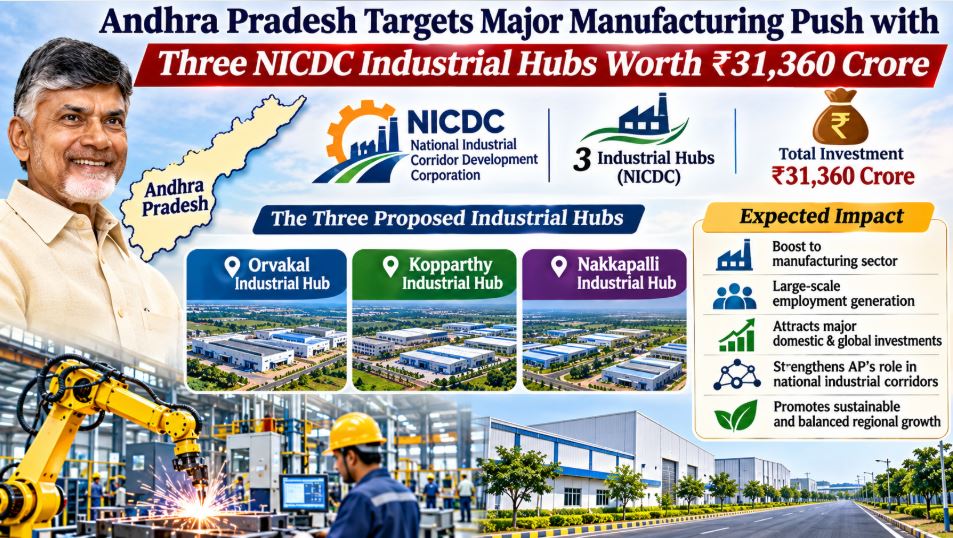
Visakhapatnam, Nov 16: Andhra Pradesh is positioning itself as a major destination for domestic and global manufacturing investments, with three proposed industrial smart city projects offering a combined investment potential of ₹31,360 crore and employment opportunities for around two lakh people.
Representational Image
The industrial prospects were highlighted by the National Industrial Corridor Development Corporation (NICDC) at the 31st CII Partnership Summit 2026, held in Visakhapatnam on November 12–13. The NICDC pavilion showcased the state’s growing industrial infrastructure, investment opportunities and progress in developing three Greenfield Industrial Smart City nodes at Krishnapatnam, Orvakal and Kopparthy.
Union Commerce and Industry Minister Piyush Goyal and Andhra Pradesh Chief Minister N. Chandrababu Naidu visited the pavilion during the summit. NICDC CEO and Managing Director Rajat Kumar Saini briefed them on the progress of the three industrial nodes and the infrastructure being developed to make them investment-ready destinations.
Spread across a combined project area of 7,223 acres, the three nodes are expected to strengthen Andhra Pradesh’s manufacturing ecosystem, attract large-scale investments and create substantial employment opportunities. Being developed under different industrial corridors, the projects are envisaged as integrated industrial hubs with modern infrastructure and connectivity.
The two-day summit, organised by the Confederation of Indian Industry (CII) in association with the Department for Promotion of Industry and Internal Trade (DPIIT), Ministry of Commerce and Industry, and hosted by the Andhra Pradesh government, brought together policymakers, international delegations, business leaders and investors.
Held under the theme ‘Navigating the New World Order: Trade | Technology | Trust | Thought Leadership’, the event focused on global trade, resilient supply chains, advanced manufacturing, artificial intelligence, critical minerals, defence technology, green energy and emerging technologies. Attracting investments and strengthening India’s position as a global manufacturing and innovation hub remained key priorities.
Apart from showcasing the three industrial nodes, the NICDC pavilion presented several initiatives aimed at improving India’s industrial infrastructure and investment ecosystem. These included the Bharat Audyogik Vikas Yojana (BHAVYA), the Industrial Corridor Land Platform (ICLP), which helps investors identify and compare verified industrial land opportunities, and Koyla Shakti, a Smart Coal Analytics Dashboard. Visitors also experienced a 360-degree virtual reality tour of NICDC’s industrial corridor projects.
India-Japan industrial cooperation gains attention
India-Japan economic cooperation emerged as another important theme during the summit, particularly in manufacturing, clean energy, pharmaceuticals, steel and semiconductors.
Addressing the Japan Country Session, Japanese Ambassador to India Keiichi Ono highlighted the growing presence of Japanese businesses in Andhra Pradesh. He noted that 31 Japanese companies operating across three cities in the state had generated more than 8,000 local jobs.
NICDC chief Rajat Kumar Saini, in his opening remarks, identified five priority areas for stronger collaboration: manufacturing and industrial corridor development, resilient supply chains, advanced technologies, sustainable industrial development, and partnerships involving MSMEs and skill development.
He also highlighted Japan’s commitment to facilitate investments worth JPY 10 trillion in India over the next decade, stressing the importance of converting investment opportunities into concrete business partnerships.
Kiyotaka Doho, Director General of JETRO Chennai, pointed to the growing interest among Japanese companies in India, stating that more than 80 per cent of surveyed companies were planning to expand their operations.
Rajesh Mittal, President and Managing Director of Isuzu Motors India, highlighted the importance of Japanese manufacturing practices, quality standards, workforce skills and strong local supplier networks in building a competitive industrial ecosystem.
Meanwhile, Andhra Pradesh Industries and Commerce Minister T. G. Bharath outlined the state’s industrial infrastructure, strategic port connectivity and sectoral opportunities. He emphasised the importance of translating investment commitments into projects on the ground.
Push to strengthen India’s manufacturing ecosystem
NICDC’s participation at the summit reflects the Centre’s broader strategy to develop globally competitive industrial infrastructure, improve logistics efficiency and connect Indian manufacturing with international value chains.
The corporation is developing Greenfield Industrial Smart Cities across various industrial corridors, with a focus on integrated infrastructure, investment facilitation and sustainable industrial growth.
With the Krishnapatnam, Orvakal and Kopparthy projects, Andhra Pradesh is seeking to leverage its industrial infrastructure and connectivity to attract investors across manufacturing and emerging sectors.
The summit provided NICDC an opportunity to engage with international investors, showcase project progress and underline the state’s potential as an industrial investment destination. The initiatives also align with the national ambition of strengthening domestic manufacturing capabilities and advancing the vision of Viksit Bharat @2047.