Rourkela, Oct 14 (UDN): Researchers at the National Institute of Technology (NIT) Rourkela have developed a patented water-purification material made from discarded jackfruit peels that removed more than 90 per cent of fluoride from contaminated groundwater during laboratory tests.
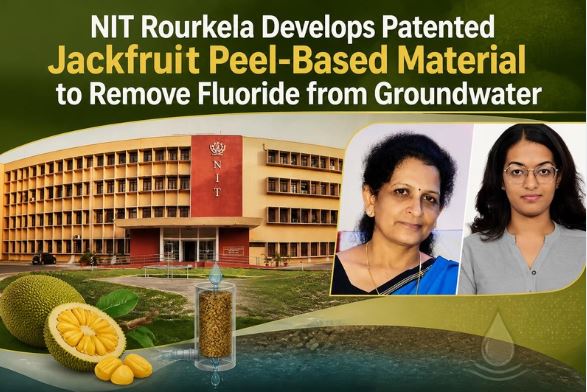
The innovation offers a potential sustainable approach to tackling fluoride contamination by turning agricultural waste into a useful resource for water treatment.
The research team converted discarded jackfruit peels into activated carbon and modified the material with zirconium to improve its ability to capture fluoride from water. According to the institute, the material achieved over 90 per cent fluoride removal in approximately 10 minutes under tested laboratory conditions.
The research was carried out by Prof. Susmita Mishra of the Department of Chemical Engineering and Dr. Pratima Minz, a research graduate at the institute. The team has secured a patent for the technology.
Excessive fluoride in drinking water can cause dental and skeletal fluorosis, making effective and affordable treatment particularly important in regions where groundwater contains elevated fluoride levels.
Existing treatment methods, including reverse osmosis and ion exchange, can have limitations such as water wastage, mineral removal and the generation of waste that requires proper management. The newly developed material could offer an alternative, although its practical performance and cost-effectiveness are yet to be established outside laboratory conditions.
Laboratory experiments recorded fluoride-removal efficiencies ranging from more than 90 per cent to 97 per cent within 10–20 minutes, at tested fluoride concentrations of around 1–5 milligrams per litre. Researchers estimated the material’s synthesis cost at approximately Rs 37 per gram, based on electricity and chemicals used in the process.
The technology has reached Technology Readiness Level 4 (TRL 4), meaning it has been validated at the laboratory level. The next stage involves developing a physical prototype and assessing its durability, long-term performance, operating costs and effectiveness under real-world conditions.
If further testing proves successful, the technology could eventually support decentralised water-treatment systems, particularly in rural and semi-urban communities with limited access to reliable purification infrastructure.
By converting an agricultural by-product into a potential water-treatment solution, the NIT Rourkela research could open a new avenue for sustainable groundwater purification. However, field trials and further validation will be essential before the material can be considered ready for wider public use.