Report calls for exposure-based standards, lifecycle-cost procurement and wider adoption of cost-effective corrosion protection to improve infrastructure durability
New Delhi, Sept 10: Corrosion is costing India’s infrastructure sector an estimated ₹1.42 lakh crore every year, but better prevention and protection measures could potentially save up to ₹49,580 crore annually, according to the CII-NRI Report on the economic impact of corrosion, presented at the CII Annual Infrastructure Summit 2026 in New Delhi.
The report identifies infrastructure as the sector with the largest absolute corrosion cost among the sectors examined. The ₹1.42 lakh crore annual cost is equivalent to about 2.9% of the sector’s GDP, while the maximum potential saving of ₹49,580 crore represents about 1.02% of infrastructure-sector GDP.
The findings come at a time when India is investing heavily in roads, bridges, railways, buildings, airports, ports and other infrastructure. Infrastructure contributes around 14.5% to India’s GDP, making the durability of these assets an important consideration for protecting the value of this investment.
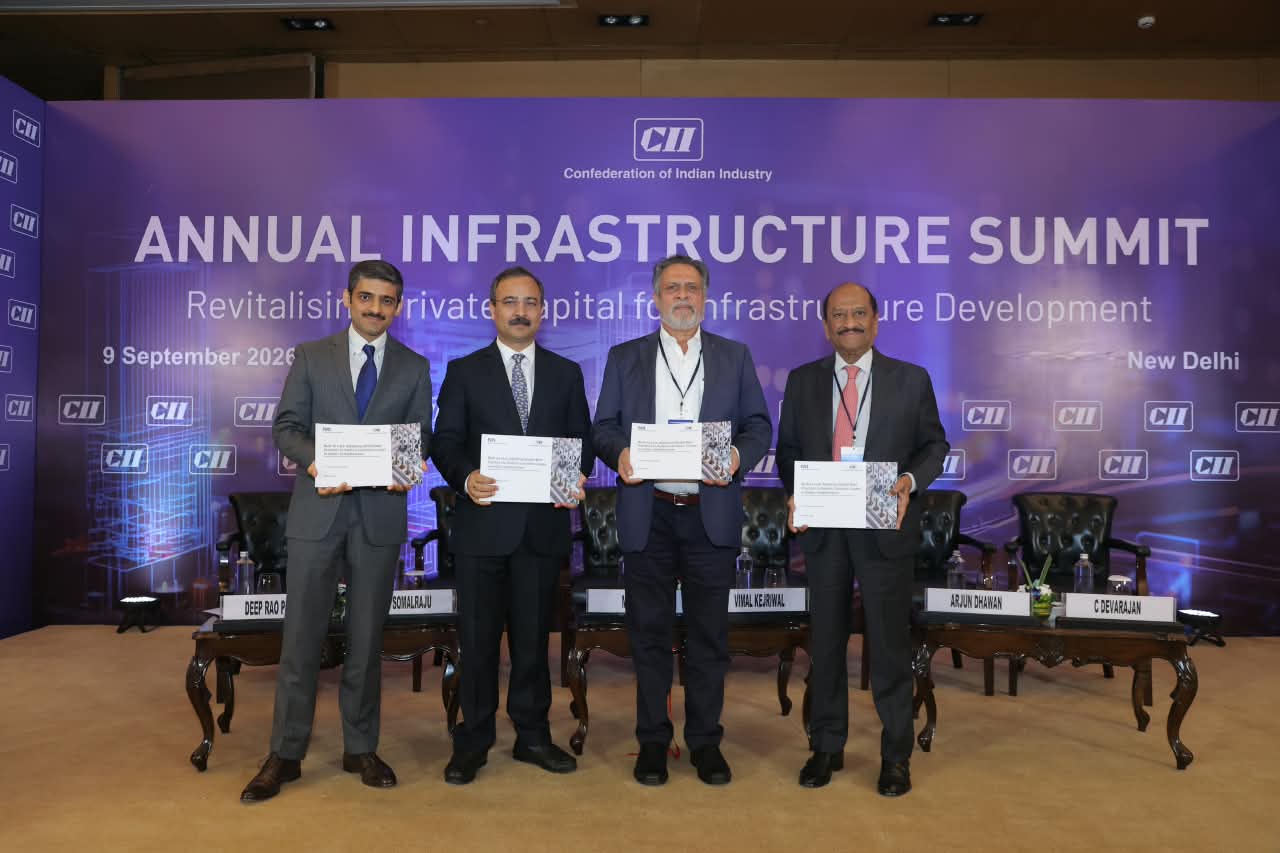
Mr. BVN Rao, Business Chairman – Transportation & Urban Infrastructure, GMR Group & Chairman, CII Infrastructure Council; M.V. Satish, Advisor to the CMD, Larsen & Toubro and Chairman, CII National Committee on Road Transport & Highways; Dr. Rajesh Kapoor, Executive Director, CII; and Mr. Ashim Sharma, Senior Partner, Nomura Research Institute Consulting & Solutions India, at the CII Annual Infrastructure Summit 2026 in New Delhi on September 9, 2026.
Ashim Sharma, Senior Partner, Nomura Research Institute Consulting and Solutions India, said: “India is building infrastructure at a scale that makes asset durability an economic issue, not just an engineering concern. The CII-NRI Report shows that corrosion represents a significant annual drain, but also points to a substantial opportunity to reduce that loss. The focus needs to shift towards preventing deterioration at the design and procurement stage, with protection selected according to the environment, required service life and lifecycle economics.”
M.V. Satish, Advisor to the CMD, Larsen & Toubro, & Chairman CII National committee on Road Transport & Highways said, “India’s infrastructure ambition must be matched by an equally strong focus on durability, & lifecycle economics. As we accelerate the creation of roads, bridges, buildings and other critical assets, corrosion must be recognised not as an eventual maintenance issue, but as a risk that needs to be addressed at the design and planning stage itself. Moving from lowest upfront cost to lifecycle value, supported by exposure-based standards and appropriate corrosion protection, will be critical to improving asset reliability, reducing avoidable maintenance and protecting the economic value of infrastructure investments. For an infrastructure landscape being built to serve generations, designing for longevity is not an option it is a fundamental responsibility.”
The report estimates that corrosion across the Indian economy costs about ₹14.15 lakh crore annually, or 4.3% of GDP. Effective corrosion-prevention measures could potentially generate savings of up to ₹4.95 lakh crore across the economy, equivalent to a 1.5% increase in GDP. Infrastructure alone accounts for ₹1.42 lakh crore of the estimated annual cost and has a maximum potential saving of ₹49,580 crore.
The case for prevention
The CII-NRI Report points to evidence of corrosion-related deterioration across buildings, bridges and other public assets, in some cases before the end of their intended service life. Examples examined in the report include the Andheri Bridge collapse, the CSMT foot-over bridge and other infrastructure failures.
The report argues that a greater part of the corrosion burden can be addressed before an asset is built, through better specifications, material selection and protection systems, rather than relying on repeated maintenance and repair.
A key recommendation is to introduce corrosion-protection requirements based on environmental exposure, particularly for coastal, high-humidity and other aggressive environments. The report notes that while the US and Japan mandate corrosion protection in highly corrosive conditions, Indian regulations often recognise such measures but leave their adoption as an option.
Lifecycle cost, not just upfront cost
The report also calls for infrastructure owners and policymakers to look beyond the initial price of a material or protection system.
The report finds that while multi-coat paint is cheaper initially, its lifecycle cost is almost twice as high because of repeated repainting. Hot-dip galvanizing costs just 10% more upfront, but can provide more than 100 years of protection without routine maintenance coating—making it a more economical choice over the life of the asset in highly corrosive environments.
The report’s approach calls for protection to be selected according to environmental exposure, asset requirements, service life and lifecycle economics.
The CII-NRI Report recommends a number of changes to Indian infrastructure practices, including:
- Exposure-based corrosion-protection requirements, particularly for coastal and high-humidity infrastructure.
- Service-life frameworks for TMT and structural steel, linked to different exposure environments.
- Better definition of coating thickness, repair and acceptance limits.
- Adoption of more modern testing methods, including magnetic gauge and eddy-current techniques.
- Stronger inspection and enforcement of corrosion-protection requirements.
- Greater use of lifecycle economics when selecting materials and protection systems.
- Training and capacity building for contractors, engineers and municipal bodies.
For roads and bridges specifically, the report recommends that India move towards robust corrosion-prevention requirements in coastal and high-humidity areas and strengthen enforcement, while allowing the protection system to be selected according to the specific environment and application.
|
|