Bengaluru, Feb 03: Industry leaders have welcomed the Union Budget 2026 for its strong focus on manufacturing, MSMEs, employment generation, and long-term economic fundamentals. These views were shared during the BCIC Post-Budget Analysis of the Union Budget 2026-27, organised by the Bangalore Chamber of Industry and Commerce (BCIC).
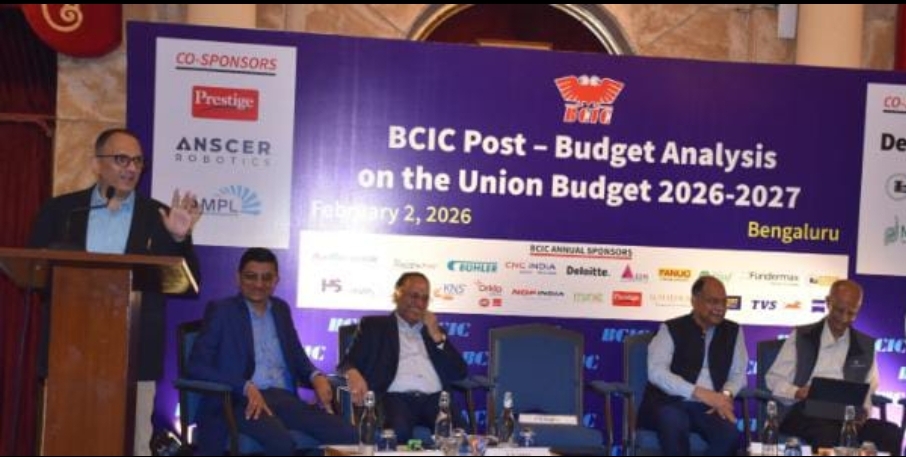
Prashant Gokhale, President of the Bangalore Chamber of Industry and Commerce (BCIC) and Managing Director of Bühler India, said the Union Budget 2026-27 takes a measured approach to strengthening economic resilience amid geopolitical uncertainty. He noted that targeted measures in agriculture value addition, infrastructure and policy clarity for data centres and IT are expected to support connectivity and the digital ecosystem. He added that the continued focus on MSMEs and manufacturing is likely to aid employment generation and sustain demand for capital goods.
“The ₹10,000 crore equity capital allocation for MSMEs, along with an additional ₹2,000 crore for micro-MSMEs is a potential ‘game changer,’ marking a shift from credit-heavy support to a more sustainable equity-based funding model,” said K. R. Sekar, Past President & Mentor, Direct Taxes Expert Committee, BCIC, and Partner, Deloitte. He also welcomed the renewed thrust on manufacturing through initiatives spanning biopharma, semiconductors, electronics system manufacturing, logistics corridors, and employment-intensive sectors such as textiles and tourism. He added that sustainable solutions to India’s unemployment challenge are intrinsically linked to stronger incentives for manufacturing and MSMEs.
Drawing from the Economic Survey, Sekar highlighted the significant improvement in MSME financial inclusion, noting that the proportion of MSMEs without access to formal banking has declined sharply from nearly 75% in 2021-22 to about 27% now. He said this shift reflects improved production levels and performance, reaffirming MSMEs as a cornerstone of India’s economic framework. He observed that the Union Budget mirrors the Economic Survey’s core themes and aligns with global best practices seen in economies such as Hong Kong and Singapore.
F R Singhvi, Joint Managing Director of Sansera Engineering Ltd., described the Budget as fiscally steady and comparable to the methodology adopted by advanced economies such as Japan. He pointed to a stable fiscal deficit path and continued efforts at debt reduction, alongside a sustained rise in allocations for education and infrastructure over the past decade. He highlighted the need to substantially increase the equity support to MSME sector and create infrastructure of testing, quality etc., for the manufacturing sector to improve the scale of operations to meet global market aspirations. At the same time, he observed that the Budget does not mark a major historical inflection and cautioned against over-reliance on government intervention at a time when India is growing at around 7%. “The private sector is sitting on significant cash reserves and must step up investment for R&D, innovations, product development etc., even as it manages shareholder expectations and risk,” he said.
From an industry standpoint, K. Ullas Kamath, founder of UK&Co and former Joint Managing Director of Jyothy Labs Ltd., said the Budget reinforces confidence in long-term policymaking rather than short-term market reactions. He said it’s in line with past budgets focussed mainly on capital investment to create world class infrastructure and ecosystem to enable Indian enterprises to be competitive in the world. In line with make in India made for the world. However, “The backbone of Indian economy, the MSMEs who are collectively the biggest employers after Agri sector continue to face constraints around credit access, delayed payments and implementation bottlenecks. The challenge lies in translating intent into outcomes”. Rs10,000 crores of dedicated fund for SME is good but not sufficient considering the sheer number of SMEs in the country adding that constructive engagement between industry and policymakers is essential for inclusive growth. Overall, it’s a very progressive budget keeping in mind viksit bharat @ 2047 he opined.
P V Srinivasan, Mentor, Indirect Taxes Expert Committee, BCIC and Partner and Chief Mentor, PVS Advisors, said,
“Our recommendation is that tax incentives extended to foreign service providers must also be made available to Indian businesses serving overseas customers, so that domestic players can build scale and compete on equal terms.”
Offering an investor perspective, Siddarth Pai, Founding Partner, CFO and ESG Officer at 3one4 Capital, said the Budget misses an opportunity to strengthen long-term investor confidence. He pointed out that global capital, particularly in emerging areas such as artificial intelligence, increasingly flows to jurisdictions with stable and predictable policy regimes. “In India, frequent regulatory changes, prolonged litigation and uncertainty around exits continue to weigh on foreign and private capital, including long-term investments in MSMEs,” he said.
The BCIC post-Budget analysis brought together industry leaders, tax experts, and investors to deliberate on the budget’s implications for the economy, manufacturing, MSMEs, startups, and employment, offering a comprehensive and sector-spanning perspective on India’s fiscal roadmap.