Japanese Researchers Unlock Key Insights into Polymer Micelle Behavior, Paving the Way for Advanced Drug Nanocarriers
Chiba University, in collaboration with Nagahama Institute of Bio-Science and Technology and Muroran Institute of Technology, has made a breakthrough in understanding how polymer micelles behave under physiological conditions—a major step forward for drug delivery and nanomedicine.
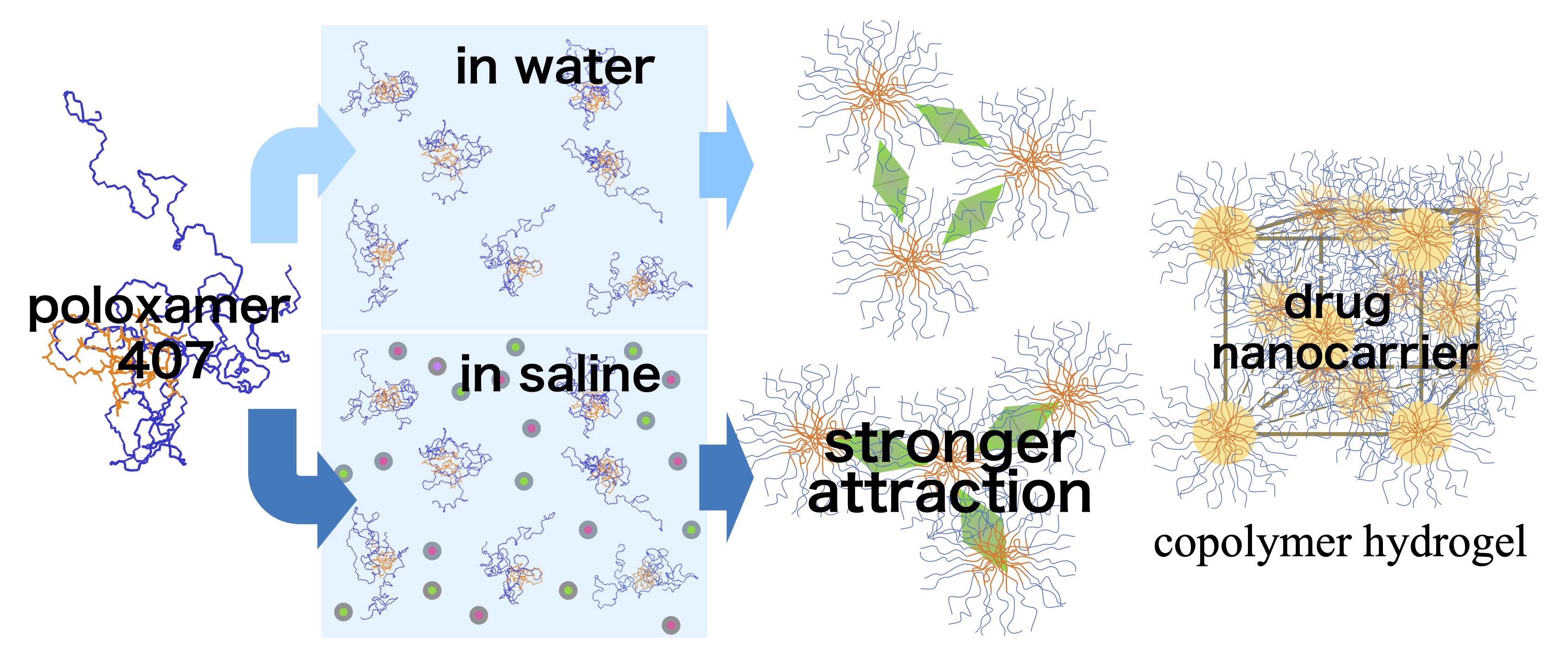
The study focused on poloxamer 407 (P407), a widely studied micelle-forming polymer known for its temperature-dependent sol–gel transition. This property allows P407 to slowly release drugs over time, reducing dosing frequency and minimizing side effects. However, the sol–gel transition is influenced not just by individual micelles but by how they interact collectively, especially in environments resembling human bodily fluids.
Led by Associate Professor Takeshi Morita of Chiba University, the research team combined small-angle X-ray scattering and dynamic light scattering to analyze P407 micelles in phosphate-buffered saline (PBS), a solution that mimics body conditions. They calculated the pair interaction potential, quantifying the forces that drive micelles to attract or repel each other at different temperatures.
The study revealed that micelles in saline bind more strongly than in pure water, forming gels with greater structural fluctuations. These fluctuations make the gels less uniform and more likely to collapse at lower temperatures, providing critical insights for designing stable and predictable drug delivery systems.
“This research provides a fundamental understanding of how polymer micelles interact and organize under physiological conditions,” said Dr. Morita. “These findings will help scientists design more effective drug nanocarriers, enhancing the delivery of poorly soluble drugs while improving patient outcomes.”
The paper, co-authored by Shunsuke Takamatsu, Dr. Kenjirou Higashi, Minami Saito (Chiba University), Dr. Hiroshi Imamura (Nagahama Institute of Bio-Science and Technology), and Dr. Tomonari Sumi (Muroran Institute of Technology), was made available online on December 9, 2025, and is scheduled for publication in Volume 707 of the Journal of Colloid and Interface Science on April 1, 2026.
This breakthrough underscores the importance of experimentally grounded approaches in soft materials research, offering a roadmap for translating nanoscience discoveries into practical medical applications.
Leave a Reply