New Delhi, Nov 26: The CSIR-National Institute of Science Communication and Policy Research (CSIR-NIScPR) has conducted a three-day training programme to help library and information science professionals integrate Artificial Intelligence (AI) into library operations, research support and knowledge management.
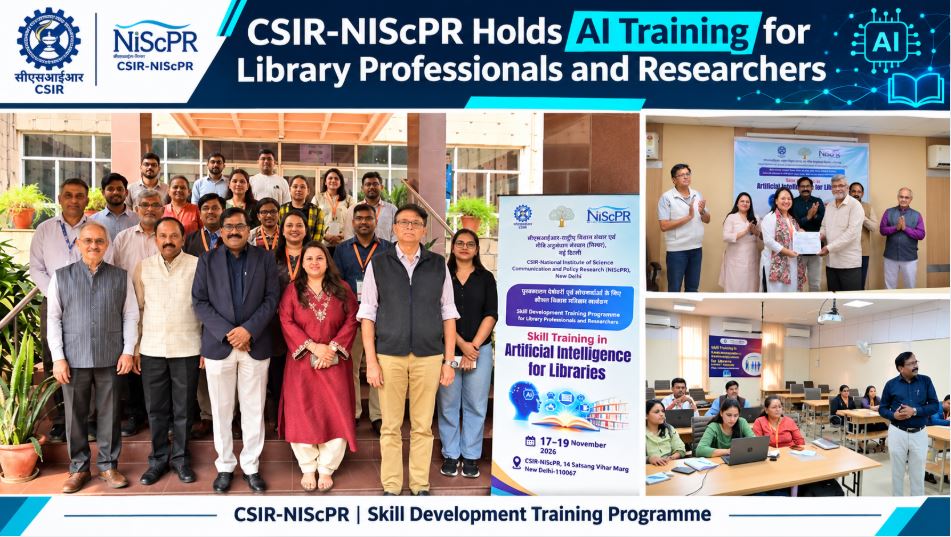
Held from November 17 to 19 under the CSIR Integrated Skill Initiative (Phase III), the programme on Artificial Intelligence for Libraries brought together library professionals, academicians, researchers, students and IT experts to explore practical applications of emerging AI technologies.
The training focused on equipping participants with skills to improve information discovery, streamline routine library work and make knowledge resources more accessible to users.
From smart cataloguing to AI-powered research support
The programme covered a wide range of applications, including AI fundamentals, chatbots, user interfaces, no-code web and app development, automated metadata extraction and smart cataloguing.
Participants also explored AI-based research discovery and mapping, regional language translation, fact-checking and information integrity. Sessions highlighted how these tools can help libraries organise information more efficiently, improve search services and respond to the changing needs of researchers and readers.
A special session on November 18 examined the use of AI tools in academic research. Dr. Ritesh Yaduwanshi, Assistant Professor at Indira Gandhi Delhi Technical University for Women (IGDTUW), conducted the session titled AI Tools for Research Support: Literature Search and Review, Summarising Papers and Checking AI Output Against Real Sources.
The session introduced participants to tools for identifying relevant research literature, reviewing and summarising academic papers, and checking AI-generated responses against credible original sources. It also stressed the need for critical assessment rather than relying unquestioningly on AI-generated information.
Responsible AI use remains central
Alongside the technical applications, the programme emphasised accuracy, transparency, ethical use and human oversight in deploying AI in library services.
Discussions highlighted the potential of AI to automate repetitive tasks and support intelligent information retrieval, while underlining the responsibility of library professionals to verify information and maintain the integrity of knowledge resources.
At the inaugural session, Mukesh A. Pund, Head of the Training Division at CSIR-NIScPR, outlined the programme's objectives and stressed the importance of building professional capabilities in emerging technologies to improve the efficiency of library and information services. Salim Ansari moderated the session.
CSIR-NIScPR focuses on professional capacity building
The programme concluded with a valedictory session on November 19, where participants were encouraged to apply the skills acquired during the training and explore the responsible adoption of AI in their respective institutions.
The initiative was coordinated by Mukesh Pund, Scientist G and Head of the Training Division. Meetali Bharti served as Nodal Principal Investigator, while Salim Ansari was the Co-Nodal Principal Investigator.
Through the training, CSIR-NIScPR aims to strengthen the ability of library and information professionals to adapt to a rapidly evolving digital environment and contribute to a more accessible, efficient and technology-enabled knowledge ecosystem.